

At the Tokyo Motor Show 2025, Suzuki Motor Corporation gave a glimpse of its multi-fuel future, showcasing CNG, CBG, and hydrogen-powered scooter prototypes.
However, the Suzuki Access CNG/CBG received the most attention. It is a dual-fuel scooter that can run on both petrol and CBG/CNG (Compressed Natural Gas/Compressed Bio-Methane Gas).
Suzuki also showcased its India-based biogas energy project, sending a clear message that the journey to carbon neutrality will be achieved not just through electric power, but through a combination of multiple clean fuels.
In today’s excellent article, we will provide you with all the information related to the highly-discussed Suzuki Access CNG/CBG scooter. To learn more, read the information provided, The information in this article is based on the well-known automotive news website, Autocarindia.
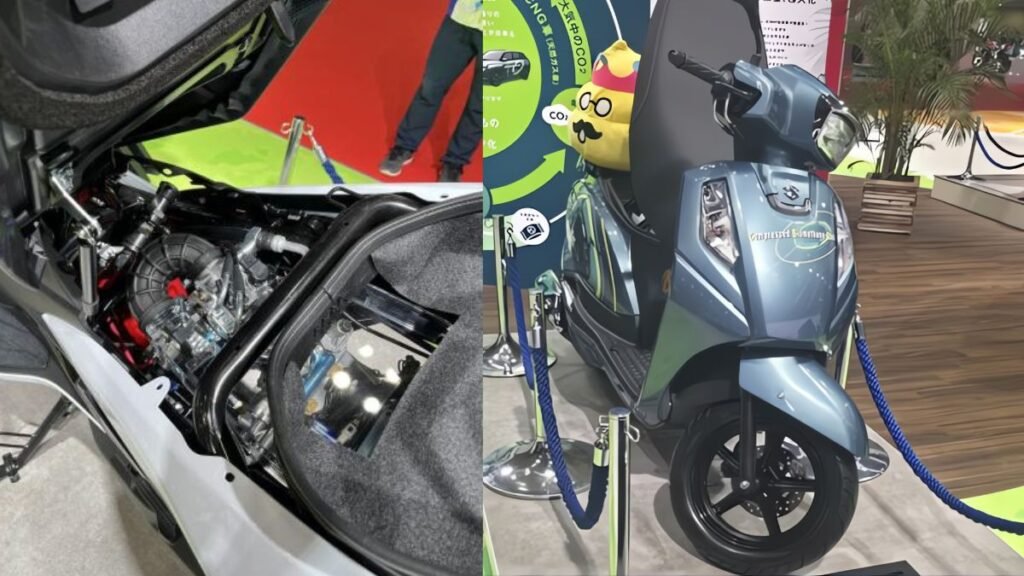
Suzuki Access CNG/CBG Prototype Details
As we’ve already mentioned, Suzuki has showcased a prototype of the Access scooter, which can run on both CNG and CBG fuel. This scooter is designed for India and offers some unique features, It features a dual-tank system, consisting of a 6-liter CNG tank mounted under the seat and a 2-liter petrol tank.
So far, you’ve only seen a CNG-plus-petrol two-wheeler, namely Bajaj’s existing Bajaj Freedom 125 CNG bike, which runs on both CNG and petrol.
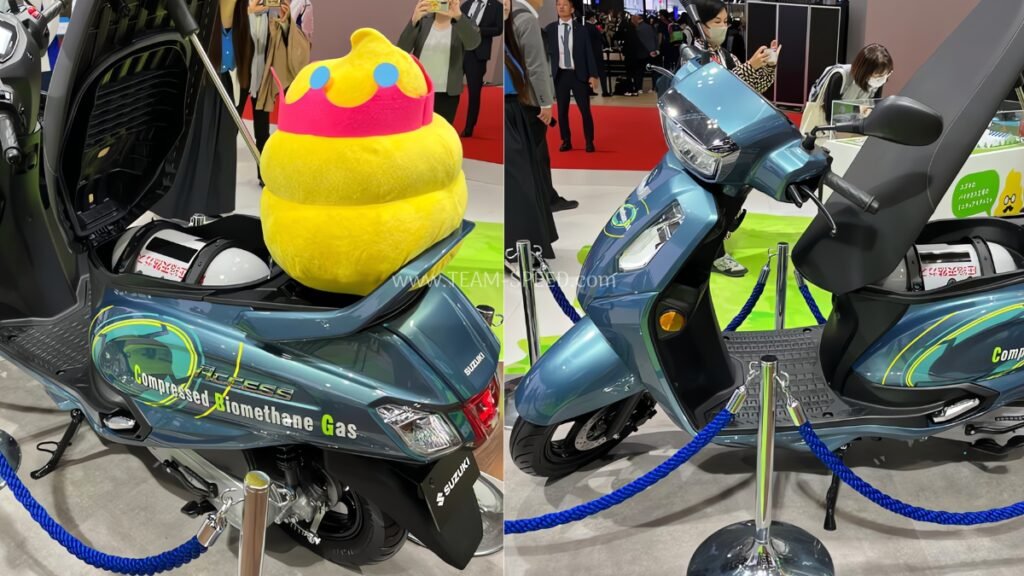
However, the Suzuki Access CNG/CBG variant can run on both CNG + CBG and petrol. In terms of range, this scooter can offer a range of approximately 170 Km with both tanks full.
In terms of weight, this prototype weighs approximately the same, but the extra tank and hardware have increased the scooter’s update by approximately 10% compared to the existing petrol Suzuki Access scooter, The design is identical to the standard Access scooter available in India.
Suzuki India-Based Biogas Project
At the 2025 Tokyo Motor Show, Suzuki demonstrated a biogas project in the form of a scale model biogas plant, which they built in collaboration with an Indian dairy cooperative.
Its main purpose is to convert dairy waste, such as cow dung, into Compressed Biomethane Gas (CBG). As we all know, CBG is a renewable fuel, meaning it is safe and sustainable for the environment.
Now, talking about the benefits of this biogas project, local villages and rural areas can generate their own energy, both pollution and emissions will be reduced, and fertilizers will also be obtained from dairy waste (as a by-product).
Simply put, Suzuki wants to create a circular energy model in India where both energy and fertilizer can be obtained from waste.